 Luxury Wellness Thailand
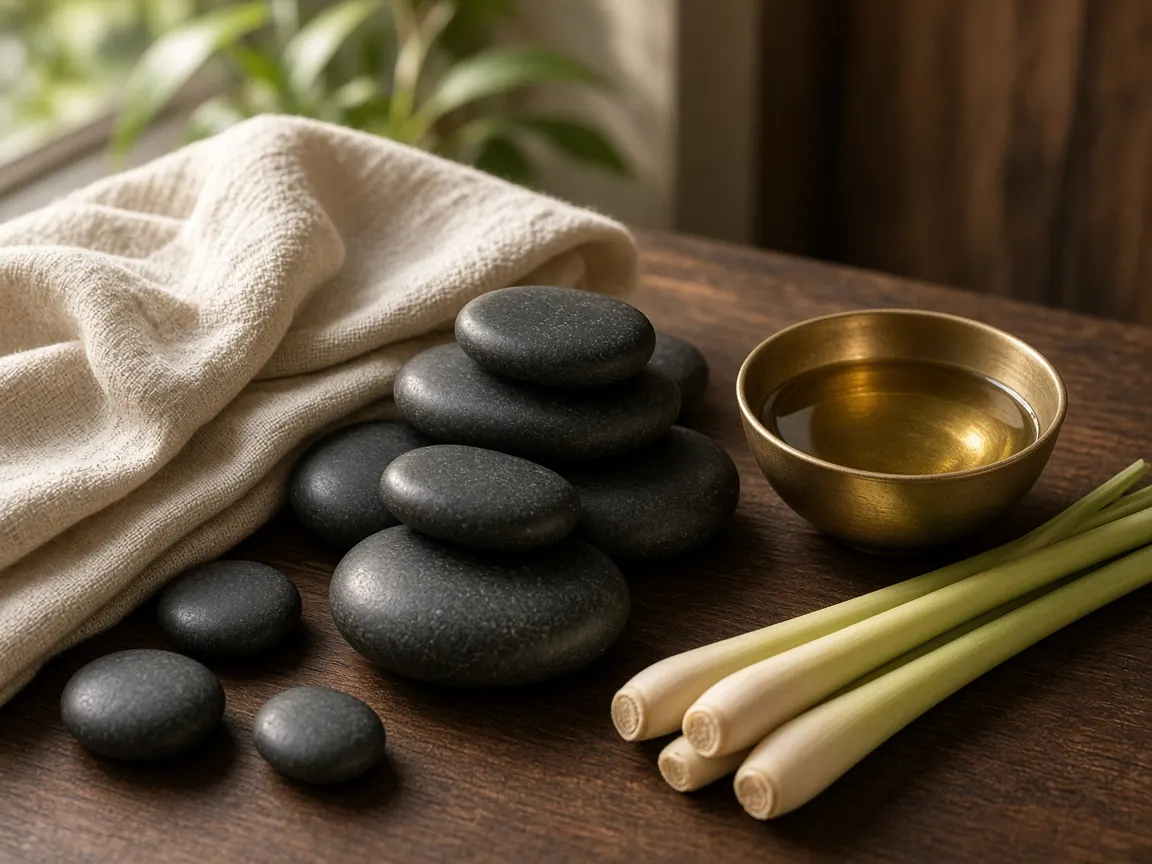
You settle onto the mat or the table, and somewhere nearby water is already simmering. A cloth ball the size of a grapefruit comes out of the steamer, trailing a scent of lemongrass, ginger-family warmth and something citrus-bright. Your therapist presses it along your shoulders, your lower back, the line of a stiff calf. The heat sinks in. The room smells like a Thai kitchen after rain.
That is the Thai herbal compress: luk pra kob, sometimes written luk prakob. It is one of the most distinctive parts of a wellness stay in Thailand, and it is often the moment guests remember longest. This guide explains what it is, what goes inside the ball, how a session unfolds, and what clinical research actually says, so you can book a thai herbal compress massage with clear expectations rather than spa-menu mystique.
What luk pra kob actually is
A Thai herbal compress is a tightly wrapped bundle of fresh or dried herbs, steamed until hot, then applied to the body with pressing, rolling and tapping motions. It is not a separate "treatment type" in the way Thai massage and oil massage are. It is a tool: heat plus plant material, used during or after bodywork.
In Thailand the compress has been used for centuries. A 2015 systematic review by Teerapon Dhippayom and colleagues in Evidence-Based Complementary and Alternative Medicine notes that herbal compress therapy is listed in Thailand's National List of Essential Medicines for muscle sprains and for muscular and joint pain. That listing is cultural and regulatory context, not a guarantee of any specific outcome for you, but it does tell you this is mainstream Thai traditional care, not a tourist invention.
You will meet the compress in three common settings:
- Spa menus, often as "Thai herbal compress massage," "herbal ball massage," or as the finishing stage of a signature treatment.
- Traditional Thai massage, where the therapist works the sen lines with hands and then follows with the warm ball.
- Private sessions at a villa or residence, where an independent therapist brings the herbs and a compact steamer.
It pairs naturally with the Thai herbal steam you may already have planned for the same afternoon. Steam first, bodywork second, compress to close: a classic Bangkok recovery rhythm.
What goes in the herbal ball
Formulas differ by school, region and therapist. There is no single official recipe. What you can expect is a mix of aromatic and warming plants from Thai traditional practice.
A concrete example comes from a 2014 randomised trial by Natthakarn Chiranthanut and colleagues, also in Evidence-Based Complementary and Alternative Medicine. Their herbal ball composition included roughly 40% plai (Zingiber cassumunar), 10% turmeric (Curcuma longa), 10% lemongrass, and other Thai herbs. The balls were steamed for about twenty minutes and applied along meridians.
In spas you will often smell:
- Plai — a pungent relative of ginger, the backbone of many compress formulas.
- Turmeric — earthy and golden.
- Lemongrass and kaffir lime — the bright top notes.
- Soft camphor or mint-family notes in some blends.
You do not need to memorise Latin names. Ask your therapist what is in today's ball, especially if you have plant allergies. Honest spas are happy to say.
How a thai herbal compress massage feels
A typical session looks like this.
- Steam the ball. The compress sits in a steamer for about 10 to 15 minutes in traditional practice (around 20 minutes in the Chiranthanut study), until it is hot but not scalding.
- Test the heat. A good therapist checks the temperature on their own forearm or the back of their hand, then on a less sensitive part of your body, before working deeper areas.
- Press and roll. The ball is pressed, rolled and sometimes tapped along muscles and soft tissue. Pressure is firm and rhythmic, more focused than a hot towel, less sharp than deep thumb work.
- Reheat as needed. The ball cools. The therapist returns it to the steamer and continues, so the heat stays even.
- Combine with massage. Many treatments use hands for Thai stretches or oil work first, then the compress on the areas that feel tightest. If you are choosing between styles of bodywork, our guide to Thai massage versus oil massage will help you decide what to pair the compress with.
Afterwards most guests describe warmth that lingers, looser shoulders or lower back, and a calm that sits somewhere between a massage and a short steam. You should feel soothed, not exhausted.
What the research actually says
Here is the honest picture. Do not let a spa brochure oversell it.
Overall, pain relief looks comparable to common alternatives. Dhippayom and colleagues reviewed 13 studies involving 778 patients. Across osteoarthritis and muscle pain, herbal compress effects were not statistically different from NSAIDs, knee exercise or a plain hot compress. There was a trend toward better osteoarthritis pain reduction versus comparators, and in postpartum care, herbal compress was associated with a shorter time to milk secretion than usual care. The review suggested plausible mechanisms: heat increasing local blood flow, anti-inflammatory constituents in the herbs, and aromatic volatile oils.
Against oral ibuprofen for knee osteoarthritis, it held its own in one trial. In Chiranthanut's 2014 study of 60 patients over three weeks, traditional Thai massage, Thai herbal compress, and oral ibuprofen all improved symptoms. Thai massage and the herbal compress were generally comparable to ibuprofen in that setting. That is encouraging for people who prefer not to take an oral anti-inflammatory for mild to moderate joint discomfort, and it is still not a reason to stop prescribed medication without speaking to a doctor.
Hot herbal compress performed well against topical diclofenac in myofascial pain research. Work associated with Jurairat Boonruab and colleagues compared hot herbal compress, plain hot compress and topical diclofenac for myofascial pain syndrome. All three reduced pain; herbal and hot compress performed well versus diclofenac on some measures. Heat itself matters. The herbs may add something; they are not the whole story.
Adding a compress to Thai massage did not clearly beat massage alone for elderly low back pain. A randomised trial by Netchanok and colleagues in Complementary Therapies in Medicine (PubMed 31987237) enrolled 140 elderly patients with chronic low back pain and compared traditional Thai massage with Thai massage plus herbal compress. There was no statistically significant additional benefit from adding the compress. That is useful nuance. If you already love Thai massage, the compress is a beautiful sensory upgrade; it is not guaranteed to outperform excellent hands alone.
Put simply: luk pra kob is tradition plus heat plus aroma, with clinical evidence that pain relief can sit in the same range as heat, exercise or common anti-inflammatories in some trials. It is not a miracle. It is a well-studied ritual worth booking when you want your recovery hour to feel distinctly Thai.
How it fits Thai traditional bodywork
The compress sits inside the same living tradition as Nuad Thai. In 2019 UNESCO inscribed Nuad Thai, traditional Thai massage, on its Representative List of the Intangible Cultural Heritage of Humanity. Compress work is not the UNESCO listing itself, but in practice it often travels with Thai bodywork: the same therapists, the same respect for sen lines, the same unhurried pacing.
If you are new to the tradition, start with our guest's guide to Thai massage in Bangkok. If you want the compress as the star of the hour, ask the spa or therapist to emphasise it rather than treat it as a two-minute flourish at the end.
When to book it on your trip
A few situations make the herbal compress an especially good choice:
- Stiff from flying or sitting. Heat into the neck, shoulders and lower back is a gentle way to arrive in your body again.
- After walking, training or a light Muay Thai class. Sore rather than injured tissue often responds well to warmth.
- As the close of a steam-and-massage afternoon. Pair it with herbal steam, then a quiet dinner. Our detox guide explains why simple recovery rituals usually beat extreme cleanses.
- When you want something more sensory than a plain hot pack. The scent alone changes the hour.
For choosing where to go, our round-up of the best spas in Bangkok for 2026 includes rooms that do compress work properly. If you prefer not to leave your residence, browse verified therapists who can bring the ritual to you, or stay somewhere from our Bangkok wellness villas shortlist and have the session in your own living room.
How to get the most from the session
Small choices change the quality of the hour:
- Say if the heat is too much. Thai compresses should feel deep and warm, never burning. Ask the therapist to cool the ball or wrap an extra cloth layer.
- Name your priorities. "Focus on my lower back and left shoulder; lighter on my neck" is perfect guidance.
- Mention allergies and skin conditions before you start. Plant constituents and heat can aggravate sensitive or broken skin.
- Eat lightly beforehand. A heavy meal plus deep heat into the abdomen is uncomfortable.
- Rest afterwards. Give yourself twenty quiet minutes and water. The point of the ritual is the state it leaves you in, not how fast you can get back into traffic.
Who should be careful
Herbal compress massage is suitable for most healthy adults with a trained therapist. Still, treat it as physical care, not as medicine.
Check with your doctor, and tell your therapist, if you:
- are pregnant,
- have reduced sensation (for example from neuropathy), which can make it harder to judge heat safely,
- have open wounds, acute inflammation, or an active skin infection in the area to be treated,
- have a known allergy to ginger-family plants, citrus, or other herbs common in Thai formulas,
- have had recent surgery, a blood clot, or take medication that affects bleeding or blood pressure.
A compress is not a substitute for medical care. If you have unexplained swelling, night pain, fever, or joint symptoms that are getting worse, see a clinician first. The research above is about symptom relief in defined study populations; it is not a diagnosis tool for you.
The short answer
A thai herbal compress massage is steamed herbs in a cloth ball, pressed into tired tissue with heat, aroma and the pacing of Thai traditional bodywork. The clinical literature suggests pain relief that can sit alongside heat, exercise and common anti-inflammatories in some trials, with honest limits: it does not always outperform massage alone, and it will not replace medical treatment.
Book it when you want your recovery hour to smell like Thailand and feel like warmth you can sink into. Ask what is in the ball, say how the heat feels, and give yourself time afterwards. That is the whole art of it.